
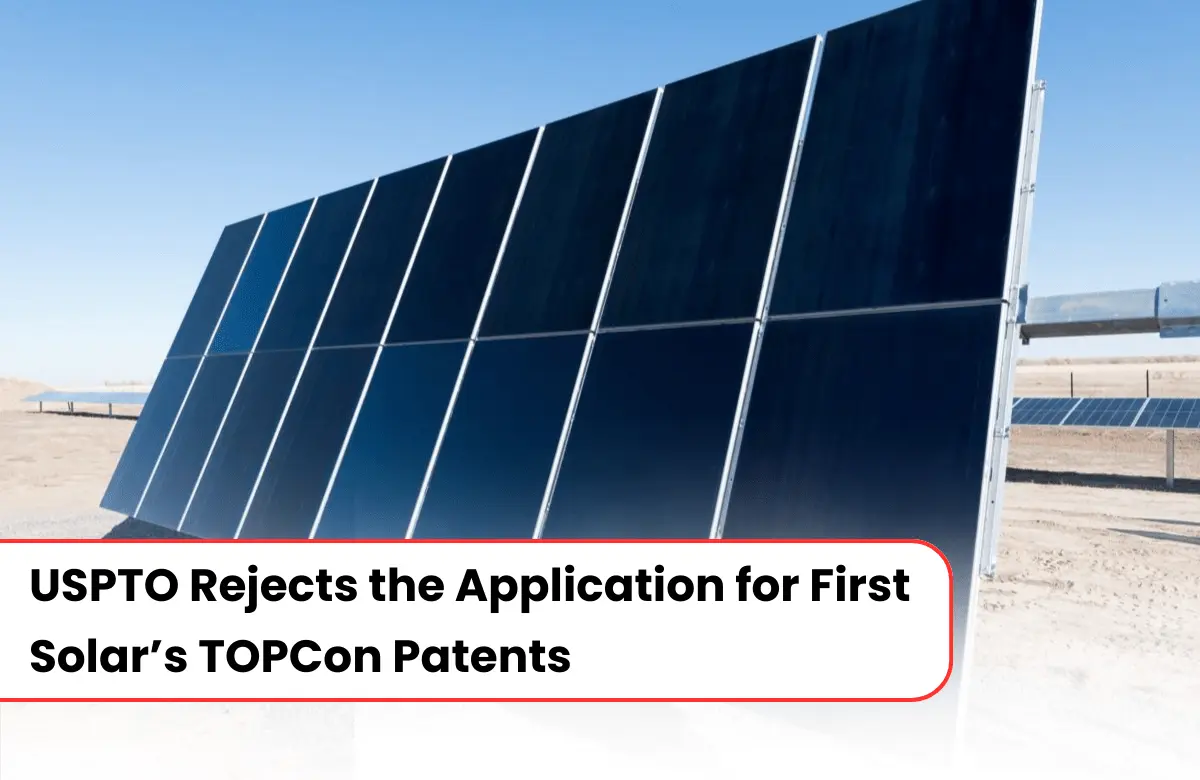
The United States Patent and Trademark Office (USPTO) has made a number of significant decisions in favor of TOPCon First Solar Patent, putting the solar manufacturing industry at a crucial legal crossroads. Three different Inter Partes Review (IPR) applications against the TOPCon First Solar Patent were submitted, but the agency’s director decided not to start trials. The Arizona-based manufacturer has reached a significant milestone with this ruling, which validates the durability of its intellectual property and guarantees that it will maintain its competitive advantage as the industry moves toward more efficient cell layouts.
The USPTO Decision on TOPCon First Solar Patent and the Strength of the TOPCon Portfolio
Major competitors worldwide, such as JinkoSolar, Canadian Solar, and Mundra Solar, filed challenges in 2025 in an effort to invalidate several of First Solar’s patents. The petitioners contended that the technology was either evident at the time it was developed or lacked the required innovation. The petitioners did not, however, present a plausible chance of success, according to the USPTO’s Patent Trial and Appeal Board (PTAB). The USPTO successfully confirmed the technical distinctiveness of First Solar’s US Patent Nos. 9,130,074 and 9,666,732, which cover basic crystalline silicon solar cell manufacturing techniques, by rejecting these objections in late 2025 and January 2026.
Read Also: Essential Information on UKIPO Fee Increases – Effective from April 2026
Navigating Modern IP Litigation in the Renewable Energy Space
The high risks of the global switch to clean energy are reflected in the increase in intellectual property litigation in the renewable energy sector. The “blueprints” for these cells have become the most valuable assets in the business as TOPCon technology surpasses earlier architectures in terms of efficiency. A proactive legal strategy is just as important as the engineering itself, as First Solar’s success in protecting its patents shows. To make sure its rights are properly upheld, the corporation is currently pursuing similar infringement claims in the U.S. District Court for the District of Delaware.
The Importance of Precision in Initial Patent Filing Strategies
The long-term benefits of a thorough Patent Filing procedure are among the main lessons to be learned from this decision. By purchasing TetraSun, Inc. in 2013, First Solar obtained this particular collection of patents. These patents’ resilience in the face of rigorous judicial scrutiny demonstrates how skillfully the initial applications were written more than ten years ago. According to First Solar General Counsel Jason Dymbort, the rulings are consistent with the “Settled Expectations” theory, which holds that an owner’s expectations of a patent’s validity should be higher the longer it is in effect without being successfully contested. These patents have a developed and thoroughly documented technological foundation because they were granted in 2015 and 2017.
Securing Long-Term IP Protection for American Solar Manufacturing
For TOPCon First Solar Patent, the decision is about preserving intellectual property protection for a technology that is quickly becoming the industry standard, not just one particular set of panels. TOPCon cells greatly improve performance by reducing electron recombination with the use of a nanometer-thin tunnel oxide layer. For this technique, First Solar has pending Patent application and issued patents in 14 nations, including China, Japan, and the EU. The USPTO protects the billions of dollars invested in U.S. industrial sites in Ohio, Louisiana, and South Carolina while ensuring that American-headquartered innovation may compete globally.
Future Outlook for IP Protection and Innovation Trends
A new age of legal accountability in the solar business is probably about to begin with the dismissal of these challenges. The conflict between genuine innovators and those who are lagging behind will undoubtedly worsen as manufacturers compete to deploy modules with remarkable efficiencies. This USPTO ruling encourages businesses to invest in R&D rather than imitation by reaffirming that original research and consistent Patent protection would be enforced by law. This gives investors and stakeholders some assurance that First Solar’s plan is legally sound, enabling the business to concentrate on increasing production to satisfy the rising demand for renewable energy throughout the world.