
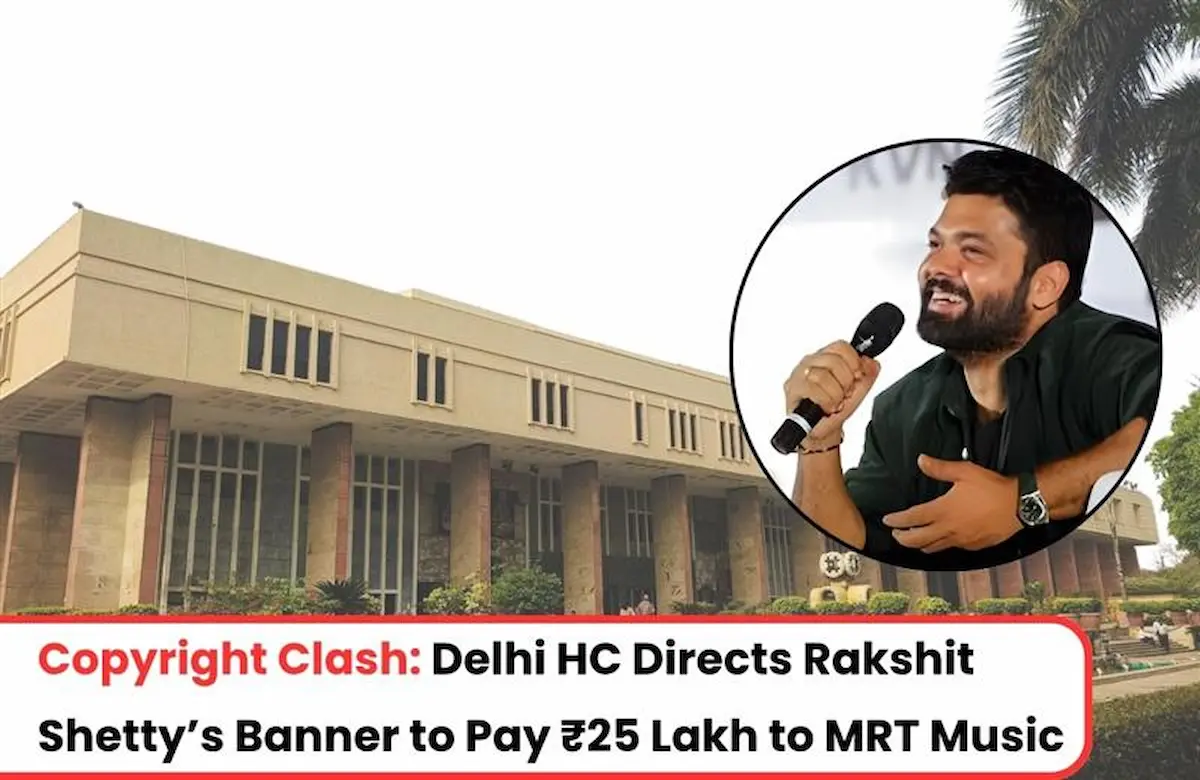
In a significant development for the Indian entertainment and intellectual property sector, the Delhi High Court recently passed a crucial order regarding the unauthorized use of musical content. The legal battle over Copyright infringement, widely known as the MRT Music vs Rakshit Shetty copyright case, has highlighted the stringent nature of intellectual property laws in India. The court directed the production house owned by Kannada actor Rakshit Shetty to pay a sum of ₹25 lakh to MRT Music. This judgment serves as a stern reminder to creators about the necessity of securing proper licenses before utilizing proprietary content in their commercial projects.
Understanding the Legal Background of the MRT Music Copyright Case
The roots of the MRT Music copyright case trace back to the film Bachelor Party, produced by Rakshit Shetty’s Paramvah Studios. The plaintiff, MRT Music, a prominent music label, alleged that the production house used two songs from the films Kirik Party and Suryavanshi without obtaining the requisite permissions. In the realm of entertainment law, using sound recordings or musical compositions without a valid license constitutes a clear instance of copyright infringement.
When a label owns the master rights to a track, any third party wishing to use that track must enter into an IP licensing agreement. Failure to do so undermines the principles of IP protection, which are designed to ensure that creators and rights holders are fairly compensated for their work. The Delhi High Court took a serious view of the matter, noting that the songs were used despite the label’s clear ownership of the audio rights.
Judicial Observations on the Rakshit Shetty Copyright Case and Damages
During the proceedings of the Rakshit Shetty copyright case, the court examined the extent of the unauthorized usage and the impact on the rights holder. The judiciary emphasized that digital platforms and film productions must adhere strictly to the Copyright Act of 1957. The court found that the defendant had indeed bypassed the legal protocols required for syncing music with visual media.
To rectify the breach, the Delhi High Court ordered Paramvah Studios to deposit ₹25 lakh as compensatory damages. This financial penalty underscores the importance of IP Protection in an era where digital content is easily accessible but legally protected. The MRT Music vs Rakshit Shetty copyright case demonstrates that the courts are willing to impose high costs to deter the practice of using copyrighted material without payment or permission.
Avoiding Copyright Infringement in the Modern Media Landscape
The primary takeaway from the MRT Music vs Rakshit Shetty copyright case is the non-negotiable nature of licensing. For filmmakers and content creators, avoiding Copyright Infringement requires a diligent approach to clearance and rights management. Every piece of music, whether it is a small snippet or a full song, is protected by law.
In this specific MRT Music copyright case, the lack of a formal agreement led to a prolonged legal dispute and a significant financial burden for the production house. This outcome reinforces the idea that investing in proper legal counsel and licensing fees upfront is far more cost-effective than facing litigation for a breach of intellectual property. Protecting one’s creative assets is important, but respecting the assets of others is equally vital for a healthy creative ecosystem.
Read Also: Apply Now: WIPO City of Innovation Awards 2026 for Visionary Global Cities
The Long-Term Impact of the Court Ruling on IP Protection
The final verdict in the Rakshit Shetty copyright case sets a strong precedent for the Indian film industry. It clarifies that even established actors and production houses are not exempt from the rules of intellectual property. By upholding the rights of the music label, the court has strengthened the framework of IP protection across the country.
As the industry evolves, the lessons from the MRT Music vs Rakshit Shetty copyright case will likely encourage more transparent dealings between production houses and music labels. Ensuring that all creative contributions are legally accounted for is the only way to prevent future instances of copyright infringement. This case will be remembered as a landmark moment that balanced the scales between independent labels and powerful production studios, ensuring that the law remains the ultimate guardian of creativity.