
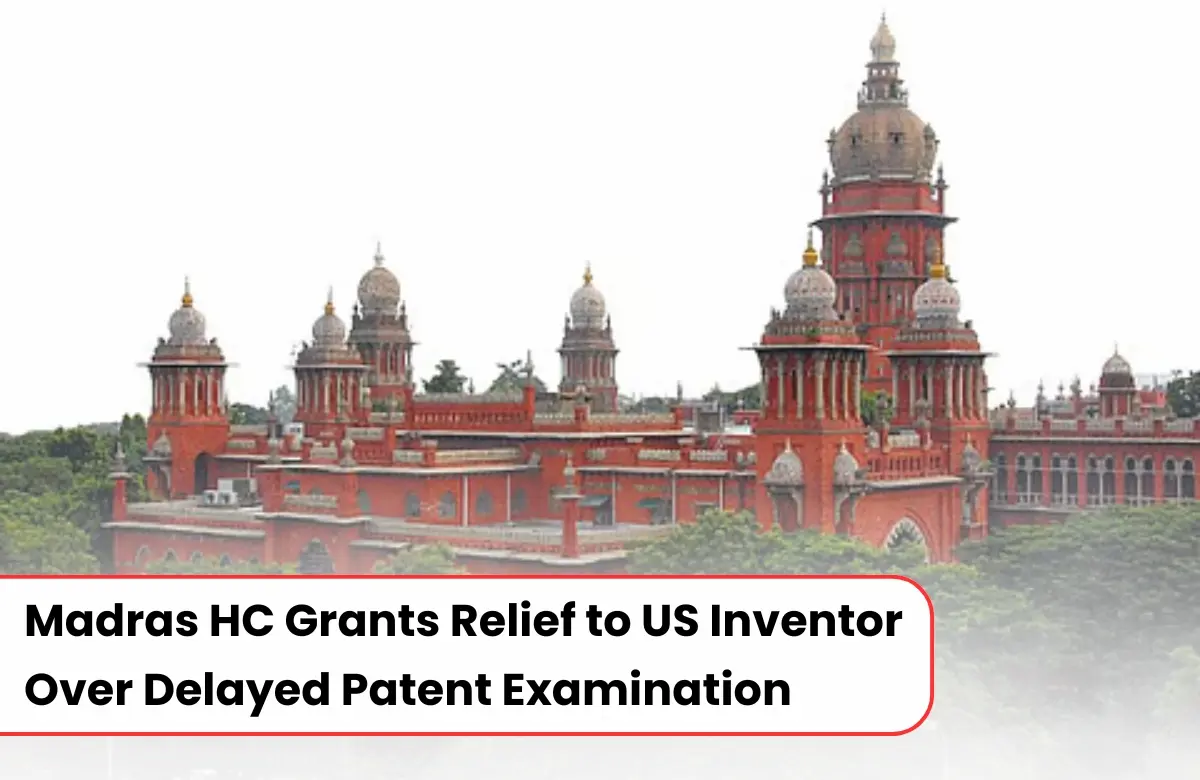
Today we have Huge news about the decision of the Madras HC patent examination delay. Timing is frequently just as important as the invention itself in the complex world of intellectual property protection. Years of study and development may conceivably come to a stop with a single missed deadline, leaving a discovery open to exploitation. But a recent historic decision by the Madras High Court has caused a stir in the legal profession, demonstrating that sometimes the spirit of creativity can prevail over strict procedural formalities, Madras HC patent examination delay change toward a more equitable strategy in intellectual property litigation is shown by the court’s decision to permit a U.S.-based inventor to move on with a patent filing examination notwithstanding a major delay brought on by their Indian agent.
The Anatomy of a Missed Deadline and the Fight for IP Protection
A U.S.-based inventor named Edward Charles Troppi Smythe was at the core of the case. He was trying to obtain a patent for an invention called “Prediction, Visualization and Remediation of Satellite Conjunctions.” In an area where strong intellectual property protection is crucial, this technique uses machine learning to forecast possible collisions between orbiting satellites. Two U.S. applications submitted in September 2021 and 2022 marked the start of the process, which ultimately resulted in a PCT filing.
The Madras HC patent examination delay dispute started when the Indian patent agent calculated the Request for Examination (RFE) date incorrectly. This request must be submitted within 48 months of the date of priority in accordance with the Indian Patent Rules. The inventor thought the deadline was in April 2025, but it had really expired in April 2024 since the agent incorrectly calculated the duration from the second U.S. application rather than the first. The Patent Office portal rejected the agent’s December 2024 filing attempt and marked the application as “deemed to have been withdrawn.”
How Global Innovation Ambitions Were Nearly Derailed by a Local Agent
Maintaining a strong portfolio of utility ideas and trademark patent assets is crucial for global innovators to dominate the market. A key component of contemporary aerospace safety and telecommunications infrastructure is the complexity of Smythe’s invention, predicting satellite collisions. The application’s rejection by the Indian Controller of Patents for missing the RFE window posed a threat to the inventor’s long-term regional strategy.
The petitioner’s attorney contended that the inventor had given the Indian agent precise instructions far in advance of the deadline. The law firm’s error in calculating the statutory term was the only internal cause of the failure. They contended that this “bona fide” mistake shouldn’t lead to the permanent loss of intellectual property rights, particularly in cases where the inventor had consistently demonstrated a desire to go after the grant and had had no plan of giving up on the innovation.
The Madras High Court’s Position on Rigid Formality vs. Fundamental Justice
When he presided over the proceedings in December 2025, Justice N. Anand Venkatesh adopted a practical perspective. The court noted that rather than creating a maze of “procedural traps” that hinder inventors, the main goals of the Patent Act are to promote innovation and offer an outline for Patent Protection. The ruling stressed that if an inventor was being careful and the delay is due to an agent’s mistake, the law should favor forgiving the delay rather than punishing the inventor.
An important factor in the court’s ruling was the Indian agent’s affidavit, which acknowledged the oversight. By emphasizing “fundamental justice,” the Madras High Court reaffirmed the notion that, although deadlines are crucial for the effectiveness of the patent filing process, they shouldn’t be applied as a strict bar in cases where a third-party intermediary is at fault, and there is no proof of “intentional abandonment.”
Navigating the Complexities of Trademark, Patent, and Intellectual Property Law
For foreign entities negotiating the Indian legal system, this decision is an essential precedent. In addition to highlighting the significance of selecting trustworthy local counsel, it provides some protection for those who become victims of administrative errors. The court’s readiness to overlook a “deemed withdrawal” status points to a more pro-applicant climate in India within the larger framework of trademark patent law and industrial designs.
In order to demonstrate that important statutory rights cannot be terminated without substantial evidence of a conscious decision to reject the application, the court cited other decisions, like Chandra Sekar v. Controller of Patents and Designs. The court ordered the petitioner to pay a small fee in order to maintain the seriousness of statutory compliance and prevent the Patent Office from becoming overburdened. This allowed the case’s merits to continue.
What This Means for Future Patent Filings and International Inventors
The lesson for inventors around the world is obvious from the huge decision about the Madras HC patent examination delay. The Indian judiciary is becoming more inclined to defend an invention’s “merit” rather than its “mechanics” of filing. This ruling is a comfort for any organization filing a patent in India. It demonstrates that a “docketing error” defense is a workable way to revive a lapsed application if it is supported by clear evidence and an agent’s acknowledgment of blame.
As India’s status as a worldwide hub for technology and innovation grows, judicial flexibility becomes increasingly important. It guarantees that the system will continue to be equitable and that a small negligence in a law office thousands of miles away won’t undo the hard work of inventors worldwide. This case will probably be used in the future as a definitive manual on how to manage the conflict between legislative compliance and professional negligence in the field of intellectual property, Stay tuned for more updates about this “Madras HC patent examination delay” case
Read Also: Beyond the Patent: Strategic Ways to Ensure Your Invention Is Fully Protected