
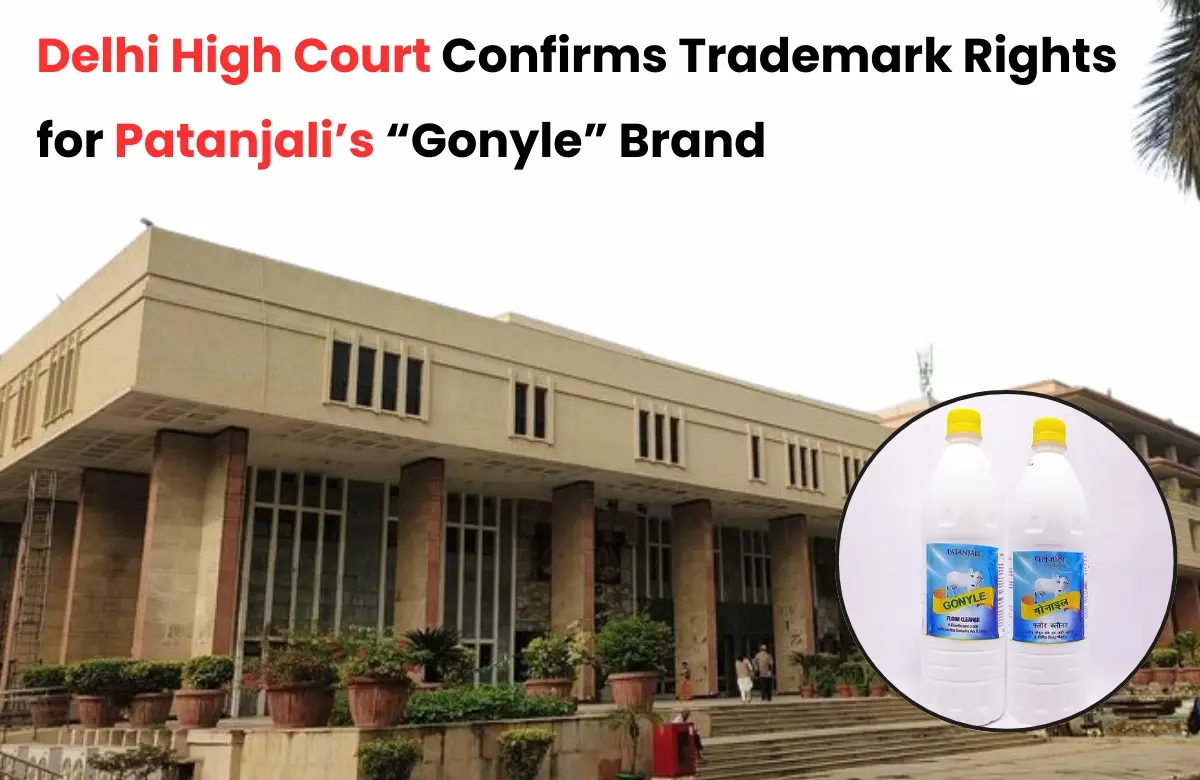
The Delhi High Court has formally maintained the legality of Patanjali Ayurved’s trademark for its floor cleaner made from cow urine and marketed under the brand name “Gonyle,” in a significant decision for India’s consumer products industry. The ruling, which was given in early 2026, puts an end to a contentious legal dispute between Patanjali and the Holy Cow Foundation (Gonyle vs Gaunyle trademark case). The court’s decision to reject the rectification petition has strengthened trademark registration and the high standard of proof needed to contest well-known names. For companies looking for strong IP protection while negotiating the difficulties of possible trademark infringement claims in the aggressive FMCG industry, this case provides an essential guide.
A Clash of Cleaners: How Trademark Registration Settled the Gonyle vs Gaunyle Trademark Case
In the case of Gonyle vs Gaunyle trademark case, The Holy Cow Foundation filed a lawsuit to have Patanjali’s “Gonyle” trademark revoked, arguing that they were the first to use the phonetically identical word “Gaunyle.” In order to avoid market confusion, the petitioner claimed that Patanjali’s branding was so similar to their own that it ought to have been excluded from the trademark registration procedure. But after carefully examining the “prior use” information, the Delhi High Court concluded that the NGO had not presented a coherent business history. This emphasizes an important lesson for all businesses: acquiring a formal registration is a strong defense, but in order to protect that registration from vigorous legal challenges, verifiable records of use must be kept.
The Shield of the House Mark: Why Patanjali’s Identity Guaranteed IP Protection
In the court’s ruling, the “House Mark Doctrine” was a key component. Millions of customers use the name “Patanjali” as their major source identification, and Justice Tejas Karia noted that it is prominently placed on the product package. Regarding intellectual property protection, the court observed that having a well-known house mark greatly lowers the possibility of customer confusion. The court determined that an average customer would differentiate Patanjali’s goods by its link with the wider brand umbrella, even if two product names bear a phonetic likeness. This prevents the mark from being invalidated as a copycat.
Cracking the Case: Why Unreliable Evidence Failed to Prove Trademark Infringement
The moving party must present “clear and cogent” proof in order to prevail in a claim of trademark infringement or to request that a public register be corrected. The court pointed out serious inconsistencies in the Holy Cow Foundation’s bills, pointing out that some of the documents had dates that did not correspond with the product’s real release onto the market. The court determined that Patanjali had not behaved in bad faith because the petitioner was unable to demonstrate that they had a solid reputation prior to Patanjali’s 2015 submission. This emphasizes that a company’s trademark rights cannot be readily taken away by the courts on the basis of inconsistent or faulty documentation.
Beyond the Ingredients: How Coined Terms Secure Trademark Registration for Traditional Products
Additionally, the petitioner tried to make the case that adopting such a name for a cleaning product could offend religious emotions and that the name was too descriptive of the ingredients (cow urine). These worries were dismissed by the Delhi High Court, which clarified that “Gonyle” is an invented phrase rather than a general term for a floor cleaner. Additionally, the court ruled that using cow-derived products for commercial purposes is a lawful business practice that does not infringe upon religious beliefs or public order. This section of the decision gives the Ayurvedic industry crucial clarification by guaranteeing that goods made with traditional ingredients can still be eligible for the full advantages of trademark registration.
Winning the Long Game: What the Gonyle Verdict Means for Future IP Protection
This decision in the Gonyle vs Gaunyle trademark case, Patanjali establishes a clear precedent for how “house brands” are viewed in Indian courts. It implies that big businesses with substantial goodwill can successfully protect sub-brands from accusations of trademark infringement by using their main brand name. For enterprises in this industry, it serves as a reminder that, while trademarks safeguard brand identity, an inventive manufacturing technique or a unique chemical composition may require patent protection to prevent rivals from replicating the underlying idea itself. This case will continue to be crucial to comprehending the complete exclusivity granted by law as the market for conventional and eco-friendly goods grows.