
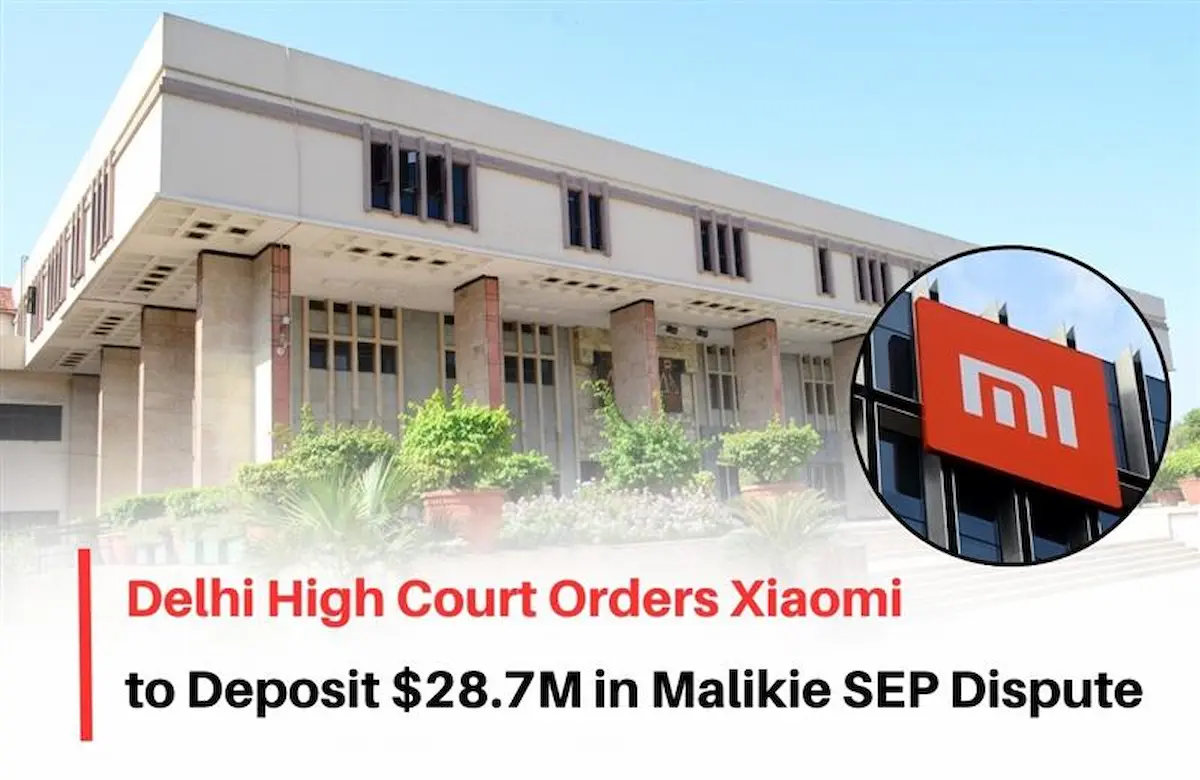
The Delhi High Court just sent a loud message to the tech world. In a recent move, the court ordered Chinese smartphone giant Xiaomi to park $28.7 million (roughly 272 crore Indian Rupees) with the registry. This isn’t a fine, but a security deposit while a massive patent fight plays out. It’s a high-stakes moment for the Xiaomi SEP Infringement Suit, proving that playing in the global tech arena comes with strict legal strings attached.
Malikie Innovations Limited started this fight. They hold what are known as Standard Essential Patents, or SEPs. Think of these as the “blueprints” for 3G, 4G, and 5G. If you want a phone to connect to a network, you have to use these specific technologies. There’s no way around it. Because of this, the Xiaomi SEP Patent Infringement Case boils down to a simple question: did Xiaomi pay their fair share to use these digital keys, or did they just help themselves?
Breaking Down the Roots of the Xiaomi SEP Infringement Suit
At its heart, this battle is about how we stay connected. Malikie claims Xiaomi has been selling devices across India that use their patented tech without a signed license. But it’s a delicate balance. In any Xiaomi SEP Infringement Suit, the court has to make sure one company doesn’t block innovation while also ensuring that IP Protection actually means something. You can’t let manufacturers use tech for free, but you also can’t let patent owners charge whatever they want.
Malikie says they tried to play nice. They claim they offered “FRAND” terms, Fair, Reasonable, and Non-Discriminatory, but couldn’t get Xiaomi to sign on the dotted line. Because negotiations hit a wall, the Delhi High Court stepped in. They decided a massive deposit was the only way to protect the plaintiff. If Xiaomi loses later, the money is already there. If they win, they get it back.
Read Also: Zee Entertainment Accuses Nykaa of Unlicensed Use of Songs in Instagram Reels
What the Xiaomi SEP Infringement Case Means for India
India is no longer a quiet sideline in the world of patent wars. It’s now a central stage. This latest order in the Xiaomi SEP Infringement Case shows that Indian judges are getting tough on SEP Patent Protection. They want to stop “hold-outs,” which is a fancy way of saying they won’t let companies keep using tech for years without paying while a court case drags on.
The court didn’t just pull that $28.7 million figure out of thin air. They looked at past sales and estimated what the royalties should have been. It’s about fairness. In this Xiaomi SEP Infringement Case, the goal is to make sure that the people who spend billions on research actually see a return on that investment. Without these protections, why would anyone bother inventing anything new?
Why FRAND Terms Matter for Global IP Protection Standards
SEPs are unique. Because they are essential, the owners are legally forced to share them—but only if the buyer pays a fair price. In the Xiaomi SEP Infringement Suit, the “fair price” is the million-dollar question. The court has to act like a referee. Was the patent owner asking for too much? Or was the manufacturer just being difficult?
Good IP Protection depends on both sides acting in good faith. In this instance, the court wasn’t convinced that Xiaomi was doing enough to settle the bill. By demanding 272 crore Rupees upfront, the court is keeping the pressure on. It’s a way to safeguard Malikie’s rights until the legal team can dig through the math and decide what the final royalty rate should actually be.
Read Also: Zee Entertainment Accuses Nykaa of Unlicensed Use of Songs in Instagram Reels
What Lies Ahead for the Xiaomi SEP Infringement Suit
This deposit is just the beginning. The Xiaomi SEP Infringement Suit is a signal to every other tech firm operating in India: get your licenses in order. The court is clearly willing to use heavy financial levers to ensure companies follow the rules of IP Protection. For global giants, the Indian market now requires a much sharper eye on their patent portfolios.
We are all waiting to see how the Xiaomi SEP Infringement Case ends at trial. It reminds us that while we all want cheap, fast tech, someone had to build the foundation for it. And those builders have rights. By forcing such a massive deposit, India is signaling that it intends to follow international standards to the letter. This isn’t just about one company; it’s about the future of how we value ideas.