
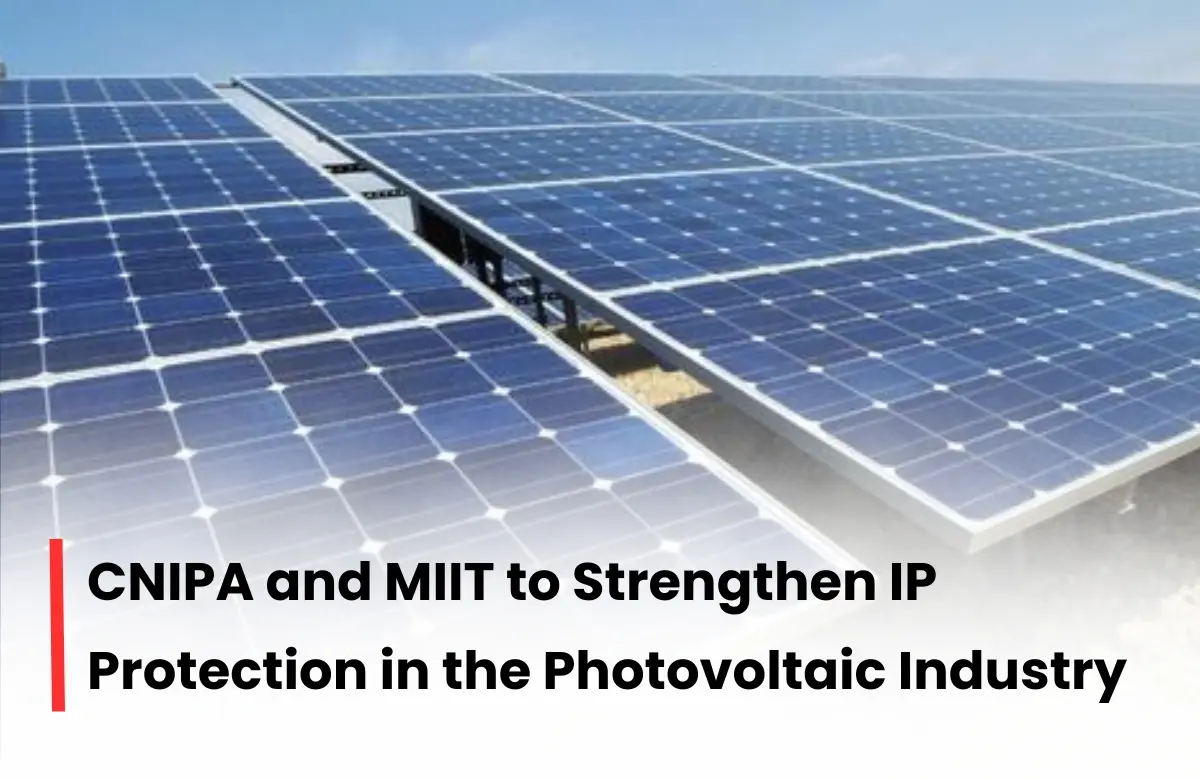
The Chinese government has declared war on “solar sabotage”, the practice of damaging internal competition and intellectual property theft, in an attempt to stabilize one of its most important economic engines. A CNIPA and MIIT new patent filing rules titled “Opinions on Further Strengthening Intellectual Property Protection in the Photovoltaic Industry” was jointly announced by the Ministry of Industry and Information Technology (MIIT) and the China National Intellectual Property Administration (CNIPA) on December 31, 2025. This project is more than just a regulation update; it is a tactical barrier intended to prevent innovative ideas from being undermined by “involution,” a term used to characterize a cycle of ruthless competition that stunts growth.
Ending the Era of Low-Value “Copycat” Innovation and Low-Quality Patent Filing
For years, the solar industry has been challenged by an influx of minor, recurring patents that provide little technological development but clog the legal environment. The new criteria are intended to shift the sector toward high-quality patent filings. CNIPA is currently asking manufacturers to focus research and development of next-generation technologies, including TOPCon (Tunnel Oxide Passivated Contact), back-contact (BC), and heterojunction (HJT) cells. By facilitating the “green channel” for patent examinations, the government ensures that businesses that push the boundaries of perovskite and tandem solar products receive protection at a faster rate, effectively encouraging those who invest in the future rather than those who repeat the past.
Read Also: Samsung Files Patent for Reversible Dual Display Flip Phone to Redefine the Foldable Market
A Comprehensive Attack on Solar Supply Chain Intellectual Property Violations
An especially extreme aspect of the new policy is the adoption of a “full-chain” surveillance mechanism. The CNIPA and MIIT will no longer confine enforcement to the final product; they will focus on each aspect of the supply chain, from raw material sourcing to finished module assembly. This proactive approach is intended to detect and mitigate IP infringement before items hit the market. By tracking IP litigation statistics and the “transfer of core technology patents to foreign entities,” the government is fostering an atmosphere in which technical secrets are protected as national assets, and those who attempt to violate these safety measures suffer harsh administrative and judicial repercussions.
The 11 Key Tasks for Solar IP Reform
The CNIPA and MIIT have identified 11 particular activities that will transform industry operations through 2027 in order to accomplish these aspirational goals:
- Promote High-Quality Patent Filing: Shifting the focus from quantity to high-value technical breakthroughs.
- Improve Examination Efficiency: Accelerating pre-examination and “green channel” processing for advanced solar tech.
- Strengthen Risk Monitoring: Establishing early warning systems for IP infringement across the supply chain.
- Enhance Administrative Adjudication: Speeding up the resolution of patent disputes through administrative channels.
- Strengthen Collaborative Protection: Encouraging cooperation between government, industry groups, and enterprises.
- Regulate IP in Procurement: Requiring non-infringement commitments in bidding for major solar projects.
- Develop Diversified Dispute Resolution: Using mediation and arbitration to settle conflicts outside of long court battles.
- Accelerate IP Transformation: Promoting the practical application and licensing of patented technologies.
- Strengthen Overseas Risk Response: Protecting Chinese solar firms from trademark squatting and litigation abroad.
- Enhance Enterprise IP Capabilities: Training personnel and improving internal compliance systems.
- Build Brand Protection: Strengthening the recognition and legal defense of Chinese solar trademarks.
CNIPA and MIIT New Patent Filing Rules: Creating an Entry Barrier with IP Protection
The CNIPA and MIIT new patent filing rules establish a “non-infringement” pledge as an essential requirement for involvement in significant projects. State-owned and central businesses are now urged to carefully examine the intellectual property records of their bidders. Businesses that have been found guilty of intellectual property infringement or are presently involved in administrative proceedings may be barred from receiving lucrative government contracts. China is imposing a self-discipline culture by incorporating intellectual property status into the procurement process. These CNIPA and MIIT new patent filing rules guarantee that better technology and legal integrity, rather than high prices based on stolen designs, will gain market share.
Improving IP Protection to Create a Sustainable Ecosystem for 2027 and Beyond
These “opinions” ultimately aim to achieve “healthy development” by 2027. To facilitate the appropriate cooperation and patent licensing of technology, industry-led patent pools and specialized “think tanks” must be established. The CNIPA and MIIT are establishing the foundation for a sustainable ecosystem in which IP protection is the main source of value through fostering a cooperative rather than predatory atmosphere. With a legal framework that is as advanced as the technology it protects, the shift from “scale-first” to “innovation-first” guarantees that the solar industry will continue to be a worldwide powerhouse.