

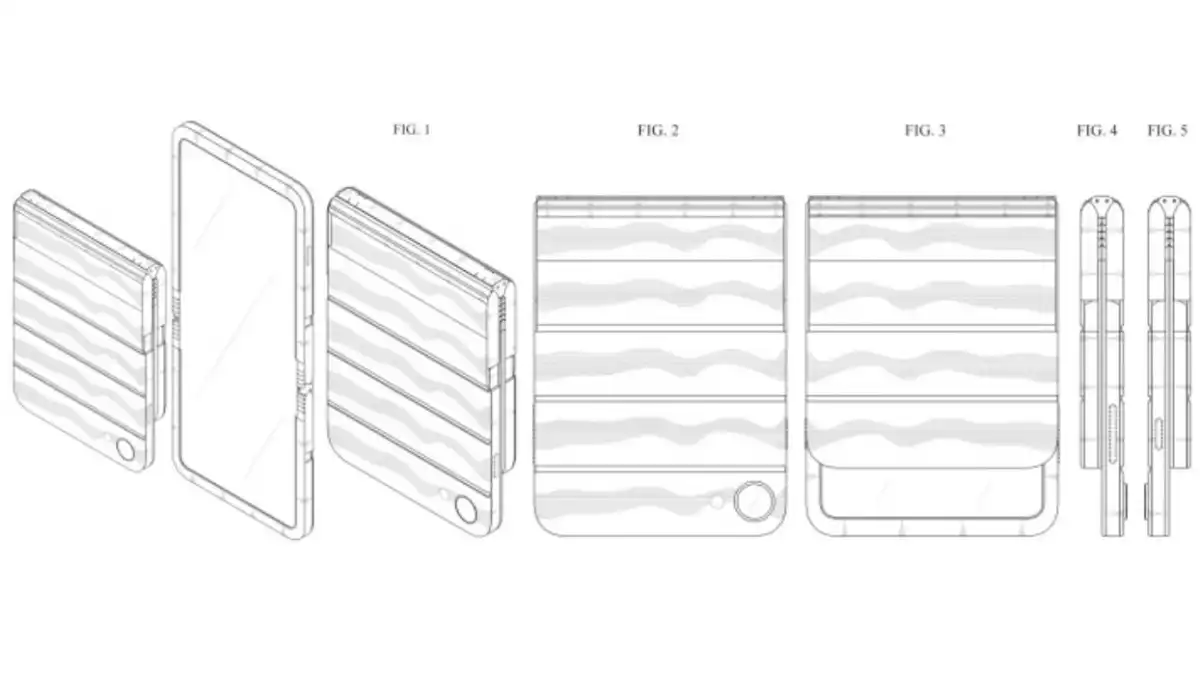
Huge update on Samsung 360 Fold Phone Patent. Although Samsung has long held the top spot in the foldable smartphone industry, the tech corporation’s most recent action indicates that its design development is far from complete. A recent patent filing displayed an imaginative new idea for the future of the “flip” form factor. This innovative concept includes a dual-display system combined with a reversible folding mechanism, which allows the device to bend both ways, as opposed to the present Galaxy Z Flip series, which uses a single internal folding screen and a smaller exterior cover display.
The Engineering Brilliance Behind the 360-Degree Reversible Hinge
A multilayered hinge mechanism that bypasses the conventional “clamshell” limitations is the central element of this invention. To preserve the main screen, the majority of the latest foldables are made to close inward. However, a mechanism that allows the device to fold both inward and outward is described in Samsung’s most recent patent application. Because of its 360-degree flexibility, the smartphone can go from a closed, protected state to a completely open tablet-like interface. It can even be folded backward to activate the front and rear displays at the same time. This adaptability solves a frequent issue for users: needing to frequently unfold the device in order to access all of the app’s features.
Read Also: South Korea and China Sign Landmark Deal to Strengthen Global Intellectual Property Protections
Dual Displays and the Evolution of User Interface Interaction
In contrast to earlier versions, this invention presents a concept in which two separate display panels cooperate. Samsung hopes to optimize screen surface area without expanding the device’s physical dimensions by using a reversible fold. The two screens can function as separate interfaces or combine to create a wrap-around visual experience when the gadget is folded outward. This design tweak is more than just an aesthetic choice; it is a deliberate move to retain Samsung’s lead in the foldable market. By doing the Samsung 360 Fold Phone Patent, Samsung makes sure that its portfolio stays different from rivals that are still refining simple inward-folding designs by continuously improving how consumers engage with glass and hinges.
Navigating the Complex World of Intellectual Property and Trademark Patent Strategy
A thorough legal procedure is required to protect the rights to such a revolutionary design. In order to preserve every possible aspect of the hinge, display layering, and software integration, Samsung utilizes a comprehensive “Patent Asset Index” technique that goes beyond a single patent filing. When a business launches a high-profile design, they often obtains a Trademark and Patent (which protects both functional utility and brand-identifying design aspects) to ensure that its “look and feel” is not imitated by others. In a sector where “copycat” designs can result in a loss of market share and brand damage, this proactive legal protection is essential.
The Legal Battlefield of Innovation and Avoiding Copyright Infringement
Samsung has to negotiate an intricate web of already-existing intellectual property as it pushes the limits of hardware. High-stakes lawsuits involving accusations of copyright infringement or patent theft pertaining to particular UI elements or mechanical constructions are common in the computer sector. Samsung’s extensive collection of foldable patents acts as a protective barrier against legal action as well as an offensive instrument for innovation. Samsung creates “prior art” through early documentation of this reversible folding mechanism, which makes it more difficult for competitors to later claim similar innovations. They are able to experiment with innovative form factors while Patent Protection technology from international competitors is ensured through this legal due diligence.
Apple’s Calculated Delay in the Global Foldable Race
While Samsung actively expands its portfolio by Samsung 360 fold phone patent, the contrast with its biggest competitor is stark. Comparatively, Apple seems to have worked extensively on the issue of foldable mobile devices before retreating. Following the filing of strong patents in 2011, the Cupertino empire has submitted few patents since. It appears that Apple will play its typical trick of not being the first to the punch, instead waiting to “get it right” until it finally enters the arena. While Samsung presently leads the Patent Asset Index, Apple’s quiet signals that it is focusing on improving the user experience rather than being a pioneer of hardware.
What Samsung 360 fold phone patent Means for the Future of the Smartphone Market
Although a patent application does not always guarantee a market release, it does provide a path forward for mobile technologies. The requirement for a separate “cover screen” would be eliminated by a reversible flip phone, which would also be able to accommodate better cameras that function while folded and unfolded. It is evident from Samsung’s continued dominance in the Patent Asset Index for flexible screens that the future of mobile is fluid rather than just foldable. In order to keep up with Samsung’s continuous cycle of innovation, other manufacturers will probably need to reconsider their hardware plans if this design is put into mass production.