
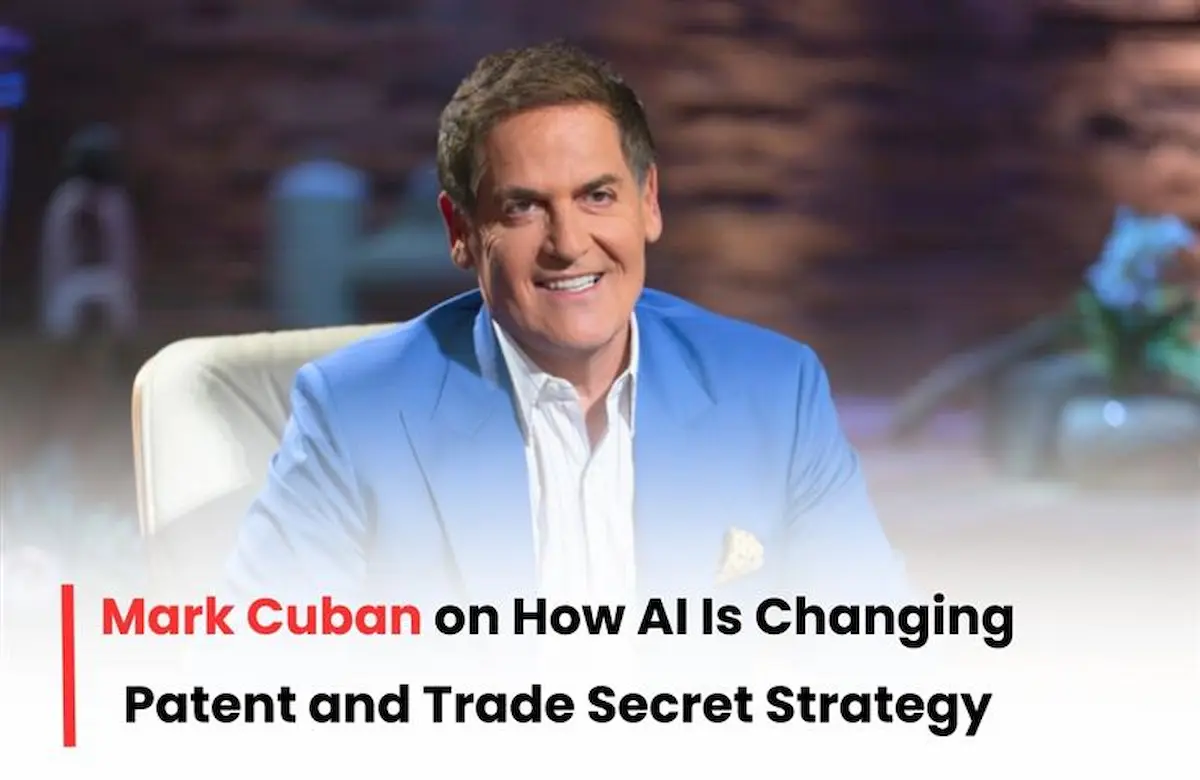
The landscape of innovation is facing a seismic shift as Artificial Intelligence (AI) redefines the value of traditional legal IP protections. Mark Cuban, the billionaire entrepreneur and high-stakes investor, has issued a bold prediction: the era of the patent filing is nearing its end. According to Mark Cuban, the rapid rise of Large Language Models (LLMs) has turned the public record into a strategic liability, effectively handing a company’s technical secrets directly to its competitors’ AI algorithms.
How Patent Filing Helps Your Competitors
The foundational principle of Intellectual Property law is a “quid pro quo” arrangement. The inventor receives a government-sanctioned monopoly for 20 years in exchange for full public disclosure. This requires the applicant to describe the invention with enough specificity that a “person skilled in the art” can replicate it.
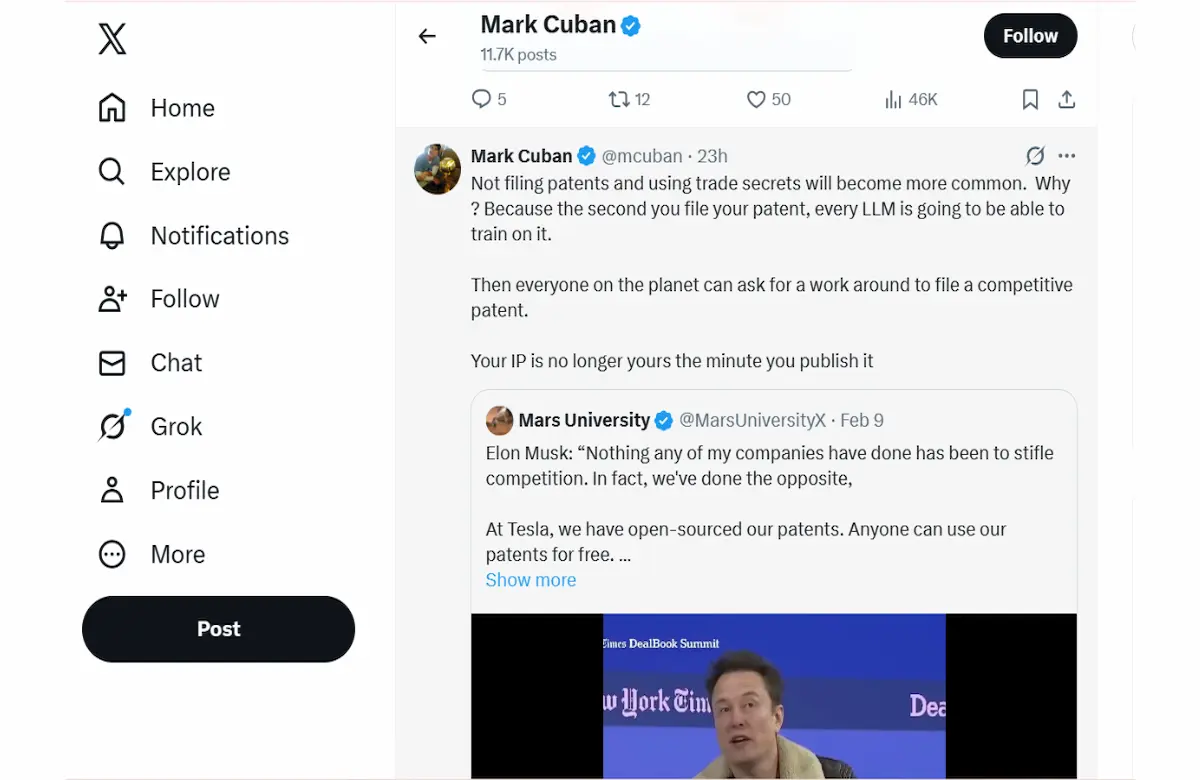
However, Mark Cuban argues that this disclosure is now a massive risk. In an X post shared on February 9, 2026, he wrote, “Not filing patents and using trade secrets will become more common. Why? Because the second you file your patent, every LLM is going to be able to train on it.”
This creates a transparency trap where the legal act of seeking IP protection provides the very data needed for AI to:
- Deconstruct Technical Logic: Instantly analyze and learn the underlying methodology of a new invention.
- Identify Loopholes: As he noted, “Then everyone on the planet can ask for a workaround to file a competitive patent.”
- Globalize Proprietary Knowledge: Once a patent is published, it is digitized and scraped by bots, making it part of the global training data for AI models worldwide.
Why Mark Cuban Believes Patents Are Risky Now
For Mark Cuban, the speed of AI-driven analysis has fundamentally outpaced the speed of legal enforcement. While a patent grants the right to initiate IP litigation, it does not provide a physical barrier to an AI learning your innovation. Mark Cuban posits that if an LLM can teach a competitor how to replicate your work in seconds, the legal right to sue becomes a secondary and often ineffective defense.
The core issues identified in this shift include:
- The End of Sharing Information: Mark Cuban warns that the traditional “publish or perish” mindset is now a strategic error because it essentially feeds a competitor’s model.
- Information as the New Gold: In an AI-driven economy, Mark Cuban has said that data and proprietary information are more valuable than gold or oil.
- Following the SpaceX Model: He pointed to the strategy of companies like SpaceX, which often avoid patents to keep their blueprints away from rivals, as the likely new norm.
Protecting Your Ideas Through Secrecy
As a direct result of these technological pressures, Mark Cuban predicts that companies will increasingly abandon patent filing in favor of trade secrets. Unlike patents, trade secrets require no public disclosure and can last indefinitely, provided the information remains confidential.
This pivot changes the entire defensive strategy for a business. Instead of relying on a government certificate, companies are focusing on:
- Security through Obscurity: Keeping high-value logic and algorithms hidden on private, encrypted servers.
- Information Siloing: Restricting access to key data sets to ensure they are not consumed by third-party LLMs.
- Contractual Dominance: Using robust non-disclosure agreements (NDAs) as the primary legal tool to prevent leakage to AI training sets.
How Legal Battles Will Change in the AI Era
If the volume of patent filing drops as Mark Cuban predicts, the focus of IP litigation will undergo a parallel transformation. Legal departments will likely see a decrease in standard infringement suits and a sharp rise in:
- Trade Secret Misappropriation: Legal battles over the unauthorized acquisition or disclosure of confidential algorithms.
- Data Scraping Disputes: Litigation against AI companies for harvesting proprietary data that was never intended for public training.
- Employee Mobility Battles: Increased scrutiny on whether departing employees are taking mental copies of trade secrets to rival AI firms.
Mark Cuban has long been a critic of the patent system, previously funding efforts to eliminate “stupid patents” that stifle small businesses. In the age of AI, he believes the system’s biggest flaw is now its own requirement for publicity. He emphasized this point recently when he wrote: “Your IP is no longer yours the minute you publish it.”
Read Also: Renault to Challenge German Patent Judgment in Dispute with Broadcom
Conclusion
The warnings from Mark Cuban reflect a new reality where silence is often the strongest form of Trademark and Patent protection. For businesses, the challenge is no longer just about whether an idea is patentable, but whether it is safe to disclose in an environment where every LLM is waiting to ingest it.
- Filing is Training: Every patent is now a textbook for your competitor’s AI.
- Secrecy is Power: The most valuable innovations are those the AI hasn’t seen yet.
- Adapt or Fail: Companies must weigh the legal benefit of a patent against the technical risk of AI replication.