European Patent Litigation in 2027: Key Trends Businesses Should Watch
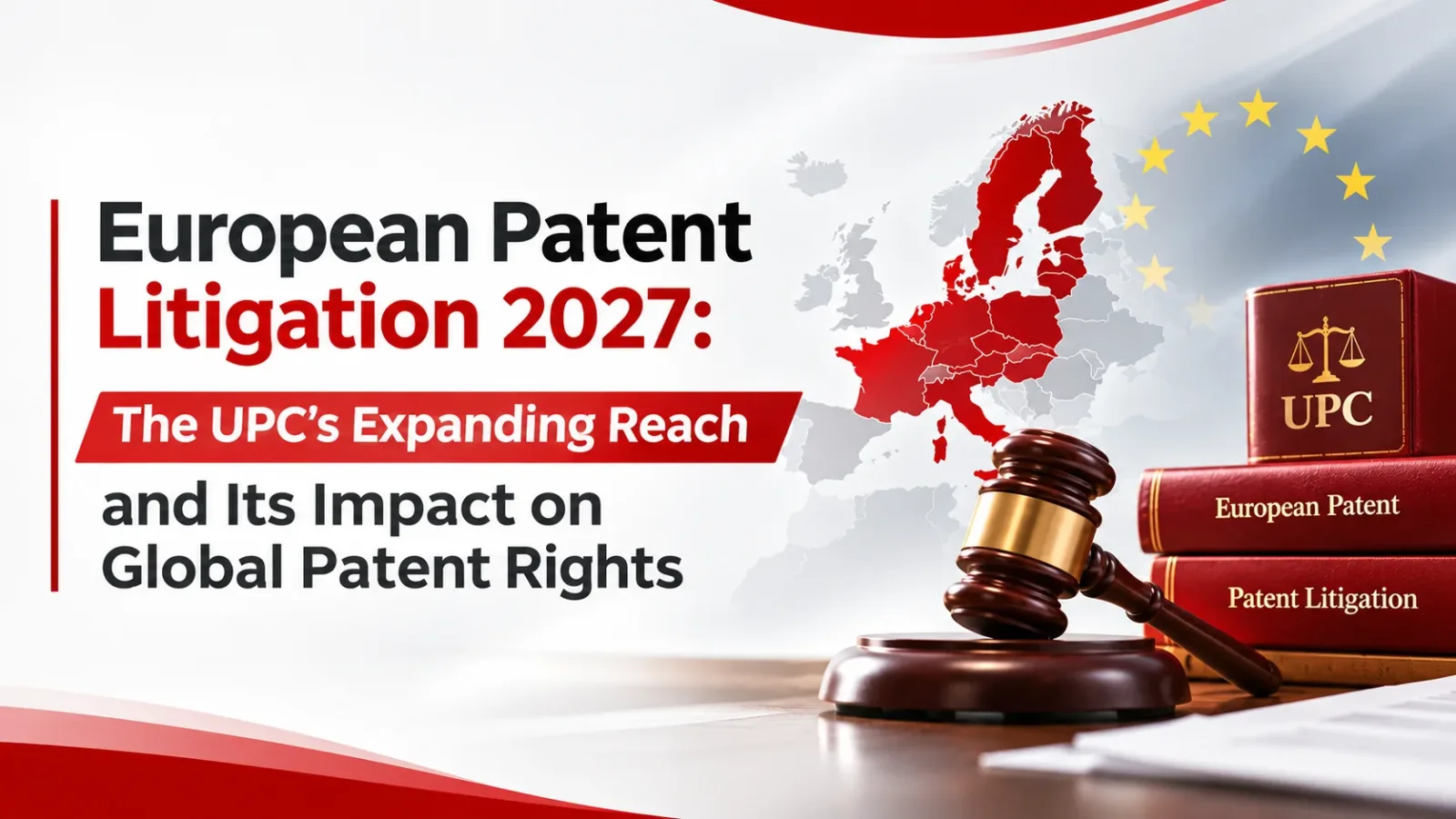
Three and a half years after the Unified Patent Court (UPC) opened on 1 June 2023, the question for proprietors and their competitors is no longer whether the court matters, but how its maturing case law alters the risk attached to a given patent or product. The UPC Agreement is now in force in 18 EU Member States. A single action may result in an injunction across all of them and, following recent jurisdictional developments, in some cases beyond.
We set out below the developments we expect to shape European patent litigation in 2027, and their practical consequences. The position stated is as at November 2026.
A settled forum, with a German centre of gravity
The UPC's own statistics record 406 actions filed at the Court of First Instance in the first nine months of 2026. Filings eased in the third quarter compared with the same period of 2025, which we read as consolidation rather than decline. The caseload remains concentrated in the German local divisions: as at February 2026, the Munich Local Division alone had received 178 of the 535 infringement actions filed since the court opened.
National courts retain a real role. They remain the only forum for European patents opted out of UPC jurisdiction, for national patents and utility models, and for states outside the system, among them Spain, Poland, Switzerland and the United Kingdom. Ireland has yet to hold the constitutional referendum required for ratification. The choice of forum, both between the UPC and national courts and between UPC divisions, is accordingly part of the substance of any European dispute rather than a procedural preliminary.
Long-arm jurisdiction
In BSH Hausgeräte v Electrolux (C-339/22, 25 February 2025), the Grand Chamber of the CJEU held that the courts of the defendant's domicile may decide infringement of foreign designations of a European patent even where invalidity is raised as a defence. Validity of designations in other EU Member States remains reserved to the courts of the state of registration; Article 24(4) of the Brussels I bis Regulation does not extend that reservation to third states.
The UPC Court of Appeal applied this reasoning in Fujifilm v Kodak (UPC_CoA_312/2025, 2 June 2026). Where a non-UPC designation lies in an EU or Lugano Convention state, such as Spain or Switzerland, the UPC will decide infringement but not validity. Where it lies outside that area, as with the United Kingdom, the court may assess validity with effect between the parties only, in deciding whether relief should be granted.
The outer limits remain open. In Dyson v Dreame (6 March 2026), the Court of Appeal made the UPC's first reference to the CJEU (C-196/26). It asks, in substance, whether jurisdiction extends to the acts in Spain of a manufacturer established outside the EU, and whether an EU authorised representative appointed under product-safety legislation may be treated as an intermediary. A ruling may follow in 2027.
The consequences are concrete. An EU-domiciled subsidiary, importer or distributor may anchor a claim covering territories well beyond its own activities. Freedom-to-operate assessments should extend to non-UPC designations capable of being asserted in the same proceedings. For proprietors, validating in non-UPC states alongside requesting unitary effect now carries greater enforcement value than it did when the system opened.
Inventive Step: The Court of Appeal's Framework
In November 2025, in Amgen v Sanofi and Regeneron (UPC_CoA_528/2024) and Meril v Edwards Lifesciences (UPC_CoA_464/2024), both panels of the Court of Appeal adopted a common, so-called holistic approach to inventive step. The objective problem is derived from what the invention adds to the state of the art, realistic starting points are then identified, and the question is whether the skilled person would have arrived at the claimed solution. An improvement is not required; providing an alternative may suffice.
The test shares features with the EPO's problem-solution approach but is not identical to it. Since an EPO opposition and a UPC counterclaim for revocation may run in parallel on the same patent, divergent outcomes cannot be excluded.
Central attack is routine: by February 2026, 454 counterclaims for revocation had been filed against 535 infringement actions. A proprietor should assume its patent will be challenged across the whole UPC territory and prepare auxiliary requests before proceedings begin. The point reaches back into drafting and prosecution. A description that records the technical effect of the distinguishing features, and claims with credible fall-back positions, are better placed to withstand this analysis.
Standard Essential Patents: Diverging Fora
The European Commission withdrew its proposed SEP Regulation in 2025, leaving FRAND questions to the courts, which do not agree. The English courts grant interim-licence declarations, and in Tesla v InterDigital and Avanci ([2026] UKSC 27) the Supreme Court allowed an implementer's claims concerning licensing terms for a patent platform to proceed. An appeal on the valuation of interim licences is listed for January 2027.
The UPC has responded firmly. The Mannheim Local Division granted an anti-interim-licence injunction in InterDigital v Amazon (December 2025) and, in Nokia v Geely (UPC_CFI_1291/2026, April 2026), a without-notice order directed at a worldwide interim-licence application before a Chinese court. In 2027 the sequence and timing of filings across fora may matter as much as the merits, and licensing correspondence should be prepared on the footing that a court may later examine it.
Costs, Procedure and Court-linked ADR
Revised court fees apply from 1 January 2026. The fixed fee for an infringement action rose from €11,000 to €14,600, for a revocation action from €20,000 to €26,500, and for an application to preserve evidence from €350 to €5,000. The reduction for small and micro enterprises increased from 40% to 50%.
Procedure remains front-loaded: the full case, evidence and auxiliary requests are expected early in the written procedure, and extensions are not readily granted. A defendant that first engages with prior art and non-infringement arguments on service of the statement of claim starts at a disadvantage.
The UPC's Patent Mediation and Arbitration Centre began offering mediation on 12 May 2026, with expert determination and arbitration introduced in phases. Its remit includes SEP and FRAND disputes, and 2027 will be its first full year of operation.
Opt-out: Revisiting Earlier Decisions
The transitional period ends on 31 May 2030, subject to a possible single extension of up to seven years; consultation on extension is not expected before 2028. An opt-out lasts for the life of the patent and may be withdrawn only once. Withdrawal is barred where national proceedings on the patent have been brought during the transitional period. Unitary Patents cannot be opted out.
Many opt-out decisions taken in 2023 rested on case law that did not yet exist. The UPC's long-arm reach, the availability of multi-territory injunctions and the settled inventive-step test all bear on that assessment, and 2027 is a sensible point to revisit it, both for one's own portfolio and for competitors' patents that may need to be challenged.
Concluding Observations
Much of the outcome of a UPC dispute is determined before any statement of claim is filed: in how the patent was drafted and prosecuted, where it was validated, whether it was opted out, how the defendant's European operations are structured, and whether a freedom-to-operate or validity position was documented before launch. This applies with particular force to businesses based outside Europe, whose European exposure often runs through subsidiaries, distributors and online channels they may not regard as litigation risks. Treating these as continuing IP management decisions, rather than questions for the day proceedings arrive, remains the most effective protection on either side of a dispute.
AnalystIP supports patent owners, businesses and their European counsel with patentability, validity and invalidity searches, freedom-to-operate analysis, infringement analysis and claim charts, and prosecution strategy for European filings, working alongside qualified representatives before the EPO, the UPC and national courts where required.
This article provides general information on developments in European patent litigation as of November 2026. It is not legal advice. The law in this area is developing rapidly, and the position in any particular matter depends on its facts, the jurisdictions involved and the applicable procedural rules. Specific advice should be obtained from qualified counsel before acting.